

THE CONCEPT
Recent developments in modern warfare have demonstrated that dominance in the electromagnetic (EM) spectrum has become a decisive factor for mission effectiveness and platform survivability. As military systems become increasingly dependent on advanced sensors, communications, radar systems and electronic networks, the ability to minimize detectability and withstand electromagnetic threats is now a critical operational requirement.
Modern defence platforms operating in contested electromagnetic environments are continuously exposed to radar surveillance, electromagnetic interference (EMI) and electronic warfare threats. In such environments, conventional protection approaches based on external coatings or metallic shielding solutions present significant limitations in durability, weight, scalability and long-term performance stability.
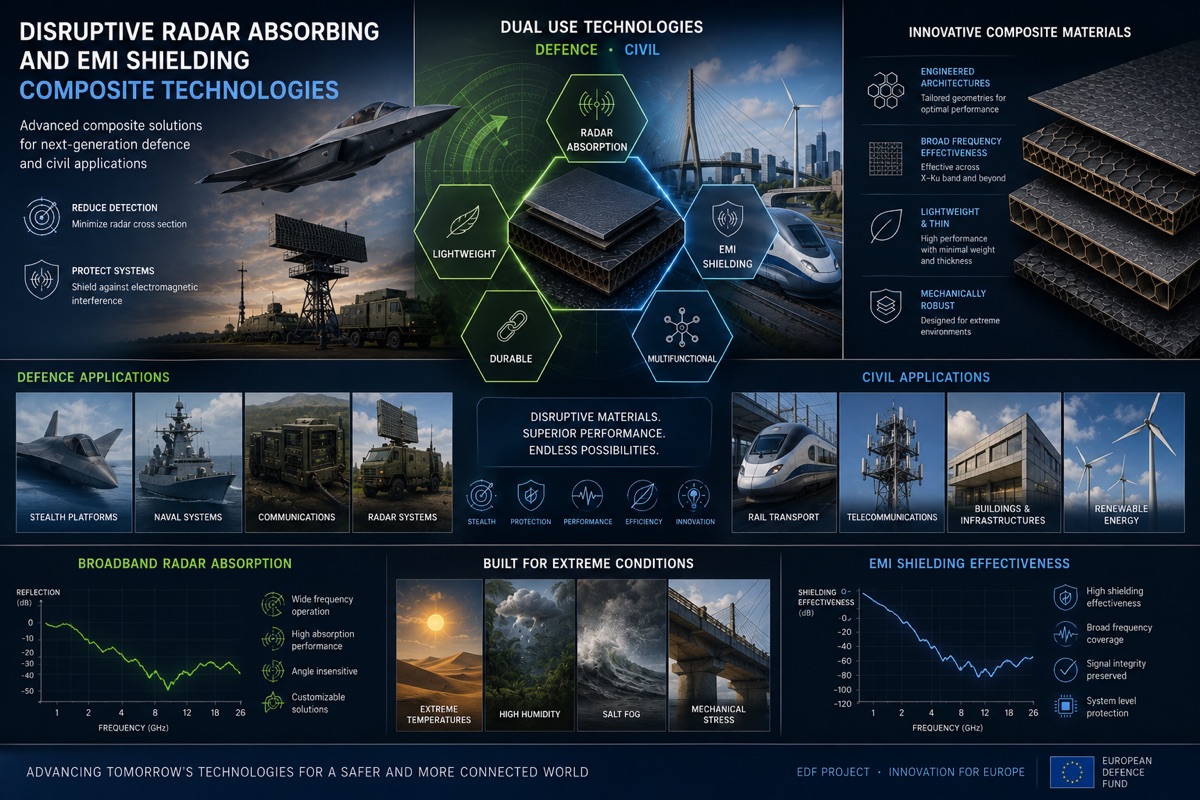
The ABBOT project aims to address these challenges by developing an innovative generation of multifunctional structural composites with intrinsically integrated radar-absorbing (RAM) and EMI shielding capabilities. Unlike conventional surface-level solutions, ABBOT embeds EM functionality directly into the structural material architecture, enabling lightweight, durable and high-performance composites capable of reducing Radar Cross Section (RCS) while simultaneously protecting sensitive electronic systems from disruptive electromagnetic effects.
Leveraging advanced material science, nanotechnology and smart manufacturing, ABBOT combines bio-based vitrimers, engineered thermoplastics and MXene nanomaterials with advanced fabrication technologies such as Automated Fiber Placement (AFP), Continuous Fiber 3D Printing and proprietary Y-PREG processing. This integrated approach enables scalable production of customizable composite structures with tailored EM response across broad microwave frequency ranges.
Through advanced simulation tools, material optimization and experimental validation, ABBOT seeks to improve the stealth, resilience, operational reliability and sustainability of next-generation defence platforms. The project also contributes to strengthening European strategic autonomy by fostering EU-based innovation and manufacturing capabilities in critical defence materials and EM protection technologies.
THE KEY OBJECTIVES TO REACH TRL4 AT THE END OF THE PROJECT
-
Requirements Definition
Define operational and technical requirements for multifunctional structural composites with intrinsic RAM and EMI shielding performance.
-
Develop & Simulation
Design and simulate material architectures and EM response, guiding selection and optimisation before laboratory validation.
-
Material Synthesis & Scale-up
Synthesise and scale sustainable composite constituents, including vitrimers, engineered thermoplastics and advanced nanomaterials.
-
Innovative Manufacturing
Advance manufacturing routes such as Y-PREG, R2R, FDM and AFP for scalable production of multifunctional composite structures.
-
Test & Validate
Validate mechanical integrity, radar absorption and EMI shielding effectiveness in controlled laboratory and relevant simulated environments.
THE KEY TECHNOLOGIES
Innovation pillars enabling ABBOT’s path to TRL4
Sustainable Composites
Vitrimers & traditional thermoplastics for durable, reparable and recyclable multifunctional structures.
Advanced Manufacturing
Y-PREG, R2R, FDM and AFP processes for precise, scalable fibre placement and impregnation.
Innovative RAM/EMI Strategies
Multiscale composites and intercalation of printed laminar patterns for tailored EM response.
RAM & EMI Shielding Simulation
Simulation and validation up to 40 GHz to accelerate design and reduce experimental risk.
EXPECTED IMPACT
- Scientific and technological contributions to disruptive defence materials
- Enhanced innovation capacity of the European defence industry
- Enhanced competitiveness and creation of new defence markets
- Enhanced defence research and innovation capacity across Europe